This article provides general medical information and does not replace consultation with a qualified medical practitioner. Suitability, risks, recovery instructions and outcomes vary between individuals.
Short answer: are compression, foam and lymphatic massage useful after liposuction?
Often, yes — but the details matter. A compression garment can support tissues and help control swelling after liposuction. Foam padding may be placed beneath the garment in selected areas to spread pressure more evenly. Short-stretch bandages may sometimes be added over the garment as an adjustable extra compression layer. Gentle lymphatic drainage massage may help mobilise excess postoperative fluid toward lymph-node basins when it is appropriately timed and not forceful.
None of these measures guarantees a perfectly smooth contour. They are adjuncts to careful surgery, appropriate patient selection, safe recovery instructions and follow-up.
Why swelling and firmness happen after liposuction
Liposuction creates controlled injury within the fat layer. In the early recovery period, bruising, swelling, numbness, tenderness and firmness are common. Fluid can accumulate in tissue spaces while inflammation settles and lymphatic drainage catches up.
Recovery is gradual. The early goal is not to force all swelling out immediately, but to support the treated tissues, avoid avoidable pressure problems and recognise warning signs that need medical review.
What compression garments do after liposuction
Compression garments are commonly used after liposuction and body contouring. They can provide external support, reduce day-to-day swelling fluctuations and improve comfort as the treated tissues settle.
A garment should be snug but not dangerously tight. Excessive pressure, rolling edges or deep fabric folds can cause pain, numbness, skin irritation or focal pressure lines. Patients should follow the garment protocol given by their surgeon rather than simply choosing the tightest garment possible.
Why foam may be used under the garment
Compression garments are made of fabric, and fabric can fold or crease. In the early postoperative period, a fold in the garment may create a narrow zone of higher pressure. This can leave pressure marks and may contribute to uneven pressure over the treated area.
Foam padding can sit between the garment and the body to help distribute compression more evenly. In selected patients, this may reduce focal pressure from creases and support smoother, more uniform early compression.
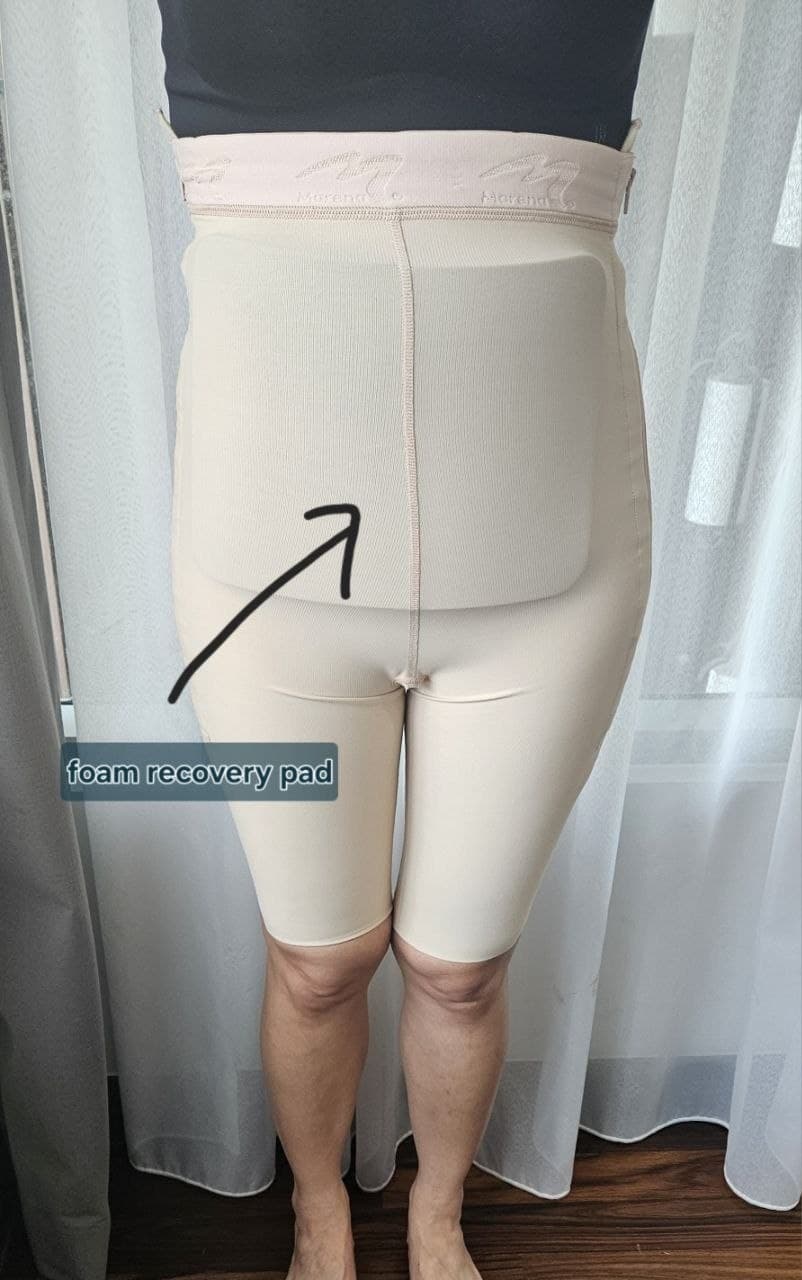
Foam is not a guarantee against contour irregularity. It is one practical tool that may be used as part of a surgeon-directed recovery plan.
Why short-stretch bandages may sometimes be added
In some patients, Dr Sun may add a layer of short-stretch bandages on top of the compression garment. This can provide an additional adjustable layer of compression and may help with postoperative swelling control and contour support.
This should not be confused with unsupervised tight wrapping. Bandages that are too tight can cause pain, numbness, skin pressure problems or circulation concerns. They should be used only when recommended and shown by the treating team.
What lymphatic drainage massage is trying to do
Manual lymphatic drainage after liposuction is intended to move excess postoperative fluid along lymphatic drainage pathways toward lymph-node basins. For some lower-body or abdominal areas, this may involve gentle movements directed toward the groin or inguinal lymph nodes, depending on the treated region and individual anatomy.
This does not require strong pressure. The technique should generally be light and rhythmic rather than aggressive deep-tissue massage. Pain should be bearable. More force is not necessarily better and may be harmful if there is significant inflammation, bruising or a complication.
Some patients may be allowed to start gentle lymphatic drainage around 2 to 3 days after liposuction if wounds, pain and the surgeon’s instructions allow. The timing should be personalised.
When not to massage and when to call your surgeon
Do not continue massage or tighten garments/bandages if symptoms are worsening or concerning. Seek medical advice promptly if you develop severe or increasing pain, spreading redness, fever, wound discharge, marked one-sided swelling, calf pain, shortness of breath, chest pain, fainting or sudden deterioration.
After liposuction, recovery support should be adjusted to the patient rather than forced through pain. If a garment, foam pad or bandage is causing focal pain, numbness or skin changes, it should be reviewed.
How compression, foam, bandages and massage work together
Compression garments and foam provide external support and more even pressure. Short-stretch bandages can add adjustable containment in selected situations. Lymphatic drainage massage uses gentle movements to help mobilise fluid toward drainage pathways. These methods address different parts of recovery and should be matched to the surgical plan.
For patients considering tummy tuck, body contouring or liposuction in Singapore, the recovery plan should be discussed before surgery so expectations about garments, foam, massage, activity and follow-up are clear.
FAQs
Should everyone use foam after liposuction?
No. Foam padding is an adjunct used in selected areas or patients. It may help distribute pressure more evenly, but it should be part of a surgeon-directed protocol.
Can foam prevent dents after liposuction?
Foam cannot guarantee prevention of dents or contour irregularities. It may reduce focal pressure from garment folds or creases, but final contour depends on many factors including anatomy, skin quality, surgical technique, swelling, compression, scarring and healing.
Are short-stretch bandages better than a compression garment?
They serve different roles. A garment provides baseline support. Short-stretch bandages may sometimes be added over the garment to provide adjustable compression, but they should not be used too tightly or without guidance.
Should lymphatic massage after liposuction be painful?
No. It should generally be light, rhythmic and bearable. Forceful massage is not required to move lymphatic fluid and may be inappropriate early after surgery.
When can I return to exercise after liposuction?
Return to exercise depends on the areas treated, extent of surgery, swelling, bruising, pain and the surgeon’s advice. Light movement may start earlier than strenuous exercise. Heavy activity should resume only when cleared.
Enquire about assessment
If you are considering liposuction or want to understand a safe recovery plan for compression, foam padding, bandages and lymphatic drainage massage, a formal consultation is needed before personalised advice can be given.