Considering plastic surgery in Korea and comparing clinics, surgeons or package costs from Singapore? Start with five checks: the individual surgeon's credentials, the operating facility, the full cost, anaesthesia arrangements and access to prompt in-person follow-up after returning home. This guide helps you compare those arrangements before booking; it does not rank or endorse Korean clinics.
The same questions apply if you are comparing plastic surgery in Thailand, Vietnam or Shanghai, China. Clinic photographs and an attractive overseas price do not answer who will examine and treat you if a complication develops in Singapore.
Before paying a deposit, request written answers to the questions below. Every operation carries risk.
| Before booking an overseas clinic | What to request from each provider |
|---|---|
| Surgeon and facility | Full surgeon name, independently verifiable registration and specialist qualifications, exact operating facility and who will perform the operation |
| Complete package cost | Itemised surgeon, anaesthesia, facility and review fees, plus responsibility for an extended stay or additional treatment |
| Anaesthesia and recovery monitoring | Named provider, qualifications, continuous monitoring and emergency arrangements |
| Follow-up after returning to Singapore | Scheduled reviews, urgent contact, agreed local in-person assessment and transfer of operative records |
| Consent and complaint route | Explanation of alternatives and risks in a language you understand, plus the applicable contract and complaint process |
1. How do I choose a plastic surgery clinic and surgeon in Korea?
Ask for the surgeon's full name, professional registration, specialist qualification and the exact facility where the operation will take place. Check these details through the relevant regulator rather than relying solely on social media, a booking agent or a certificate image.
A facility licence and a surgeon's qualification are separate checks. Ask whether the facility is authorised for the procedure and proposed anaesthesia. Confirm who will actually perform your operation and how any change of surgeon would be discussed and consented to.
Discuss suitability, alternatives and risks in a language you understand. Photographs and reviews cannot guarantee your result. Establish whether the person recommending a package is your clinician or a booking intermediary.
2. What does plastic surgery in Korea cost—and what is included?
Request an itemised quotation covering the surgeon, anaesthesia, facility, recovery care, medicines and planned reviews. Ask what is excluded, what any revision policy covers and who pays if treatment is postponed or complications require a longer stay.
Add flights, accommodation, time away from work and a contingency for additional treatment. A lower package price does not necessarily mean a lower total cost. This guide does not quote Korean prices: a useful comparison requires current, personalised quotations.
If you are also comparing a plastic surgery price list from Thailand, request the same procedure and scope of care from both providers.
Discuss the timing of travel with your treating team rather than treating an advertised itinerary as medical clearance. CDC identifies additional risks around surgery and air travel, including blood clots. A suitable return date depends on the operation and the patient's circumstances. CDC
3. What happens if I develop a complication after returning to Singapore?
A video call is useful for communication, but it cannot replace an in-person examination when one is needed. Some postoperative complications are time-sensitive. A delay in assessment or treatment can allow a manageable problem to worsen, so a plan that depends only on messages or a future return flight may be inadequate.
Before booking, clarify who is responsible for follow-up while you are overseas and after you return. Request a written plan covering scheduled reviews, a 24-hour urgent contact, where you can obtain same-day in-person assessment, and who is responsible for additional treatment or an extended stay. Ask whether the overseas clinic has a named local partner in Singapore; do not assume a Singapore clinician has agreed to take over routine follow-up unless that arrangement has actually been made.
Ask for copies of your operative report, anaesthesia record, discharge instructions and relevant implant details, so subsequent clinicians can understand what was done. CDC medical-tourism guidance recommends planning continuity of care, verifying qualifications and obtaining medical records. CDC

4. Who will provide and monitor my anaesthesia?
Ask the clinic:
- What type and depth of anaesthesia is planned?
- Who administers it, and what are their qualifications?
- Who stays with me throughout—and are they responsible for other patients simultaneously?
- What monitoring, emergency equipment and transfer arrangements are available?
- Who monitors me during recovery?
Why a dedicated clinician matters
Sedation can become deeper than intended, suppressing breathing or obstructing the airway. Without prompt correction, low oxygen can lead to brain injury or cardiac arrest. Anaesthetic drugs can also depress blood pressure and heart function. “Sedation” does not mean risk-free care. Korean sedation guidelines
The surgeon must concentrate on operating. Monitoring breathing, circulation and anaesthetic depth—and responding to changes—is a separate responsibility. Do not assume the surgeon can provide dedicated anaesthesia care while operating.
WHO-WFSA standards call for continuous presence of a trained, vigilant anaesthesia provider; ASA standards require qualified anaesthesia personnel throughout general anaesthesia, regional anaesthesia and monitored anaesthesia care. These are professional standards, not every country's law. WHO-WFSA · ASA
What Singapore requires
For ambulatory surgical centres covered by MOH's licence conditions, general anaesthesia requires a specialist anaesthesiologist separate from the surgeon. During anaesthesia, that specialist must focus only on administering the anaesthetic and monitoring that patient, without other tasks. This supports dedicated care rather than sharing that role across simultaneous patients. Acute hospitals have separate rules. MOH, paragraph 3.2
Korean multidisciplinary sedation guidelines published in 2024 describe themselves as non-mandatory. That does not establish all current Korean legal requirements or prove a country-wide safety comparison. Ask how your particular clinic implements monitoring and emergency safeguards. Korean guidelines
5. What do reported deaths tell us?
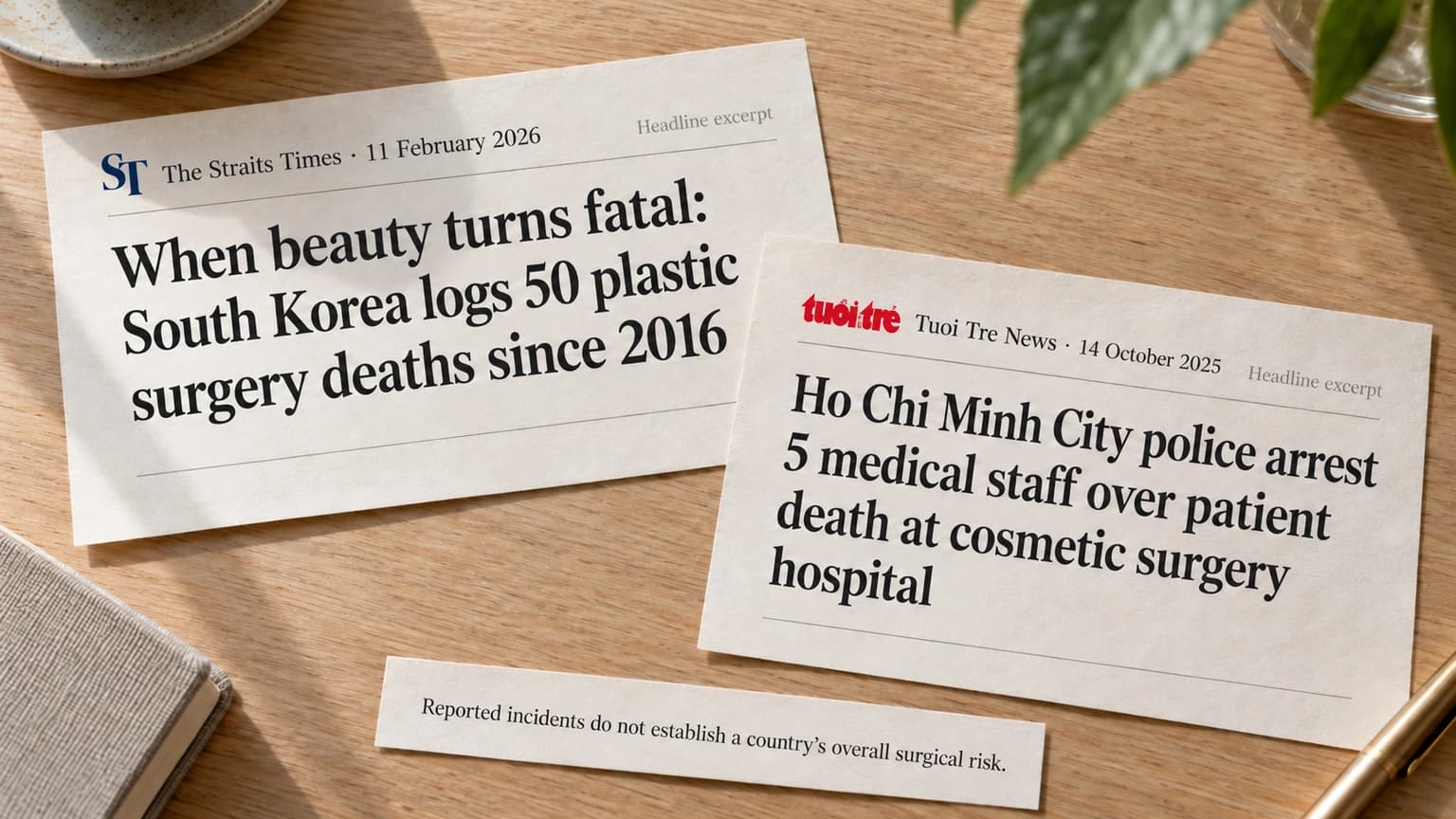
A 2025 Korean forensic study examined 50 aesthetic-procedure-related deaths referred for autopsy during 2016–2024. Anaesthesia-related deaths were the largest category. This selected series cannot establish a national mortality rate or compare Korea's safety with Singapore's. Study
An official Vietnamese report dated 14 October 2025 described charges following a patient's death, including alleged registration and authorisation breaches. It reports an investigation, not a final verdict. Official report
These incidents reinforce the need to check the individual surgeon, facility and care plan; they do not establish that every clinic in a country is unsafe.
6. What should I know about cross-border complaints and disputes?
If a dispute arises after overseas surgery, seeking redress may involve unfamiliar procedures, language barriers, translated medical records and additional costs. Before booking, ask for the written complaint process and clarify which law and jurisdiction apply to your agreement. Keep copies of your consent forms, quotations, correspondence and clinical records. Obtain advice from a lawyer qualified in the relevant country if a dispute develops; this guide does not assess whether a particular claim would succeed.
Frequently asked questions
Is plastic surgery in Korea always cheaper than Singapore?
An advertised package price is not a complete comparison. Obtain itemised quotations and include travel, recovery, reviews and contingency costs. This guide does not establish that either destination is always cheaper.
Can remote follow-up replace an examination in Singapore?
A video consultation can help communication, but cannot replace an in-person examination or treatment when needed. Confirm local assessment arrangements before booking rather than relying on an urgent return flight.
Checklist before paying a deposit to an overseas clinic
Before paying, confirm the named surgeon, operating facility, dedicated anaesthesia arrangements and access to prompt in-person assessment after returning home.
Before paying, also ask:
- Who is the urgent contact outside office hours?
- Is there a named clinician or facility in Singapore that has agreed to assess me?
- Who pays for assessment, additional treatment or an extended stay?
- When will I receive my operative and anaesthesia records?
- Which complaint, mediation or legal route applies if care goes wrong?
A clear, verifiable answer to each question is more useful than a promise that a destination or package is universally safe.